A Temple in the Middle of a Road in India
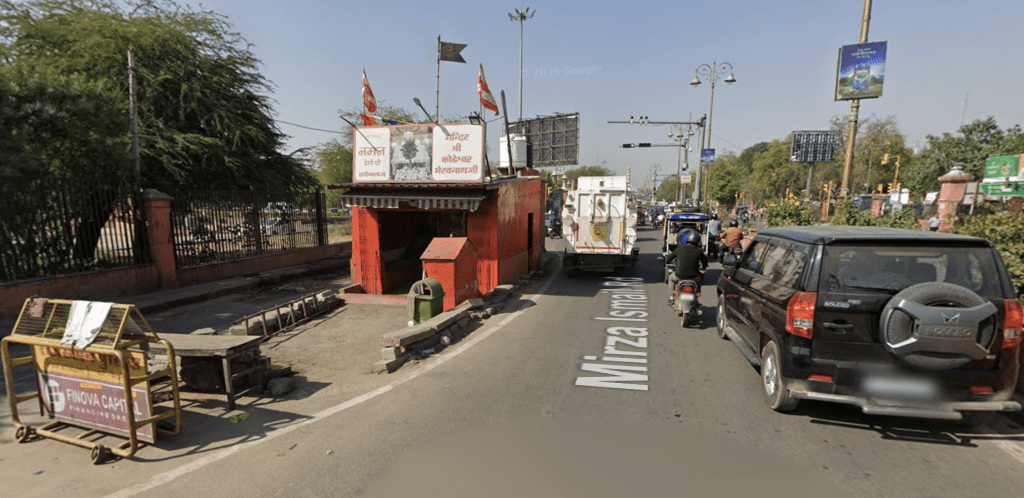
There’s a temple in the middle of one of Jaipur, India major highways. Not beside or near like Google Maps suggest, but directly in the path of economic progress. From a distance it looked like a road construction project or some leftover debris that someone forgot to clear away. I was looking for a crosswalk for humans or a flashing “merge” sign for vehicles or even a concrete barricade for safety. But there was nothing.
My first thought wasn’t “the holy of holies”. It was “what the fuck, this is ridiculous.” The entire multi-lane highway had to negotiate and swerve in thick traffic, losing its flow to allow for this spirit, this god, the temple is devoted to. There was this cynical indignation inside of me. My internal critic was talking; India has no problem displacing thousands of people to widen a street for a metro line or bypass. But they wouldn’t move this temple just a few measly meters? They were willing to compromise the safety of the people, creating a permanent, high-speed bottleneck for a flag and some prayer vessels?
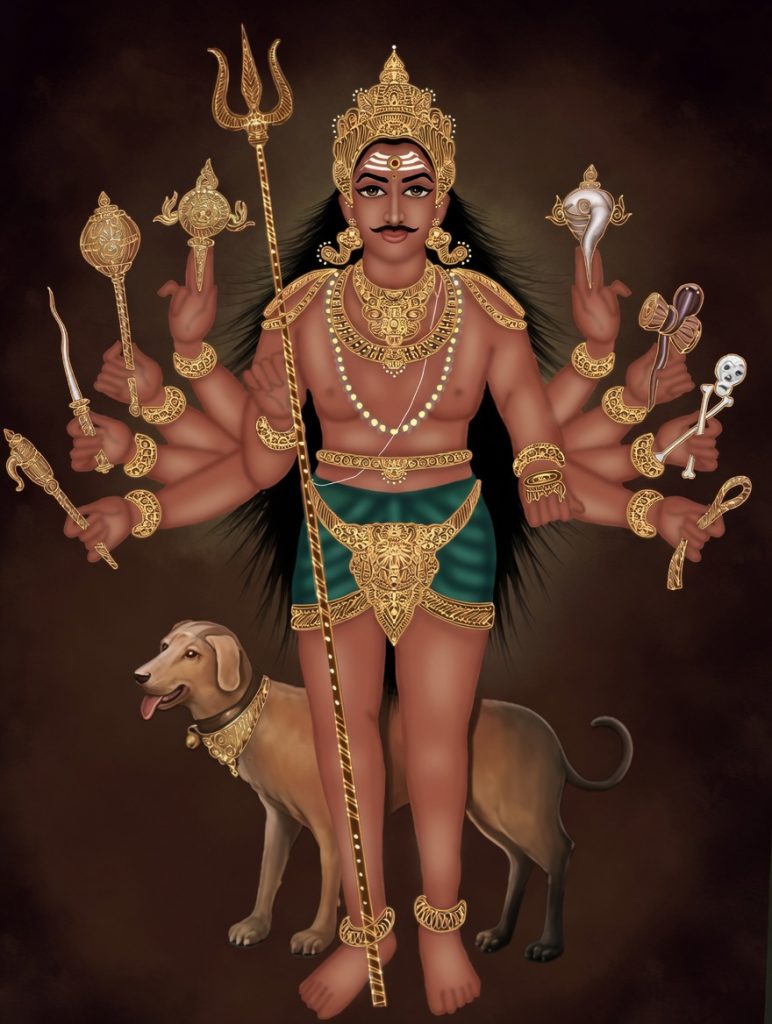
It felt like a threat. Not spiritual, but systemic. I was reminded that in this place, the “fixed structure” of the divine is more real to this culture that the safety of any human. It was a big “fuck you” to the Western idea of the “greater good”. I stood in the middle of the highway gazing at this temple the way people drive by a car wreck. Busses filled with children swerve around me without a second glance – the kids waving at me while the bus driver performed a high-speed prayer. The absurdity to it all was one of those India head-scratching moments.
Then I saw the name on the map, Bhairava.
It was then I realized the government wasn’t being respectful. They were being cautious because this was a different kind of “friction.” Bhairava is a manifestation of Shiva who could care less about the safety of your commute. He is the god of thresholds, where the ego gets dismantled and the illusion of order dissolves into the mess of reality. Indian civil road engineers knew what I was just beginning to feel: that you can negotiate with displacing a few of the living, but you cannot negotiate with a deity that represents destruction itself. The temple wasn’t an obstacle to the highway. The highway was a temporary, flailing attempt to move around something that had always been there.
I keep reminding myself how I had come to India to move with the rhythm of the place. But standing in the exhaust-choked shadow of a god that refused to move for a bulldozer, I realized how much I still wanted the road to be straight. I wanted the world to make sense. I wanted the government to be “logical.” But Bhairava was there to remind me that the demand for logic is just another ego we hold onto when the chaos gets too close.
The Contradiction: Government vs. Religion
This situation reveals something more complicated than cultural curiosity or spiritual symbolism. The presence of this temple in the middle of the road exposes a leak in the authority of the modern state.
In India, infrastructure projects are ruthless. Routinely displacing entire communities, particularly those with the least power to resist. Informal “settlements” are cleared, families are relocated, and development proceeds under the guise of “economic progress.” The logic is consistent and, from a planning perspective, understandable… until it hits a shrine.
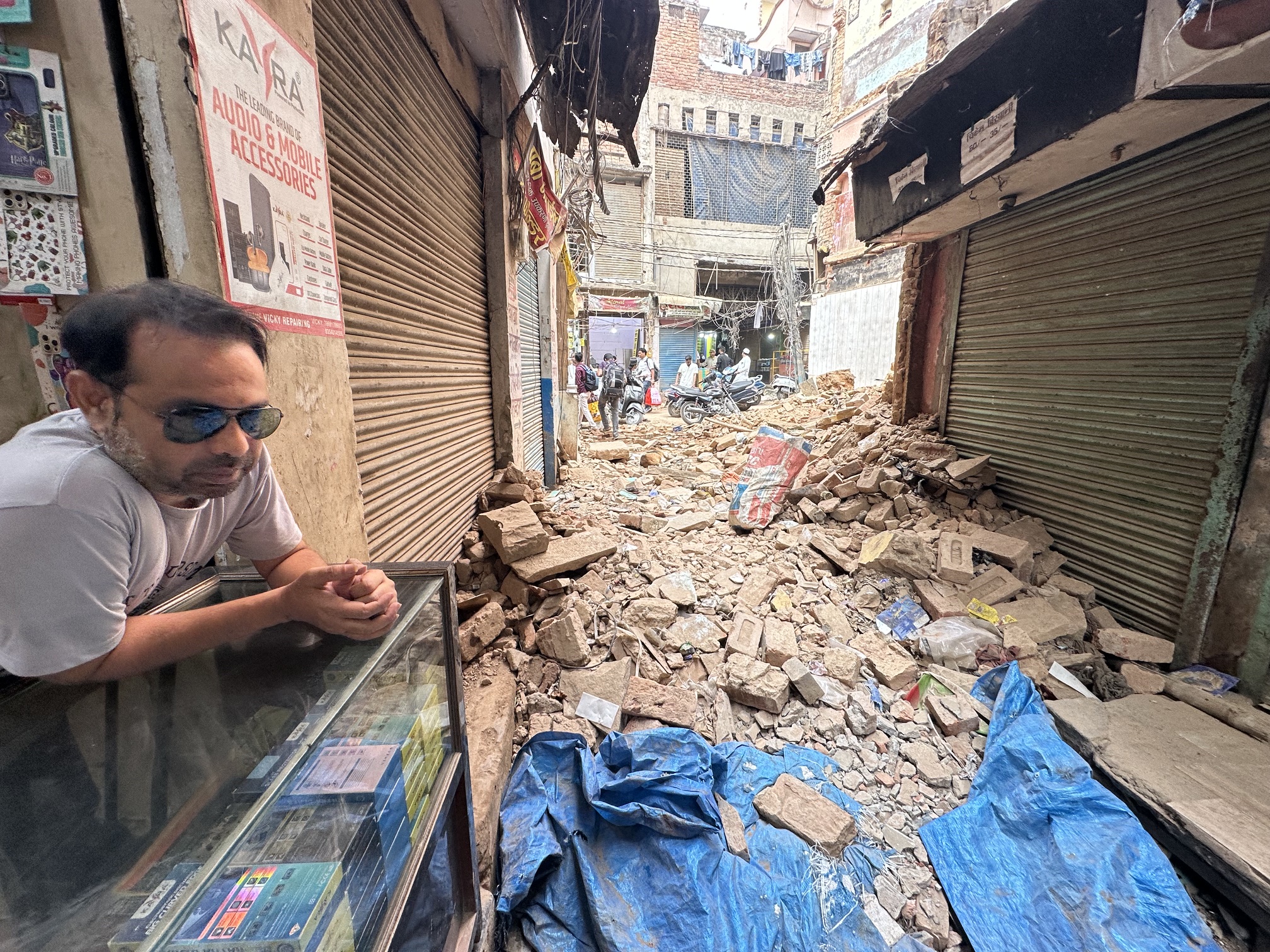
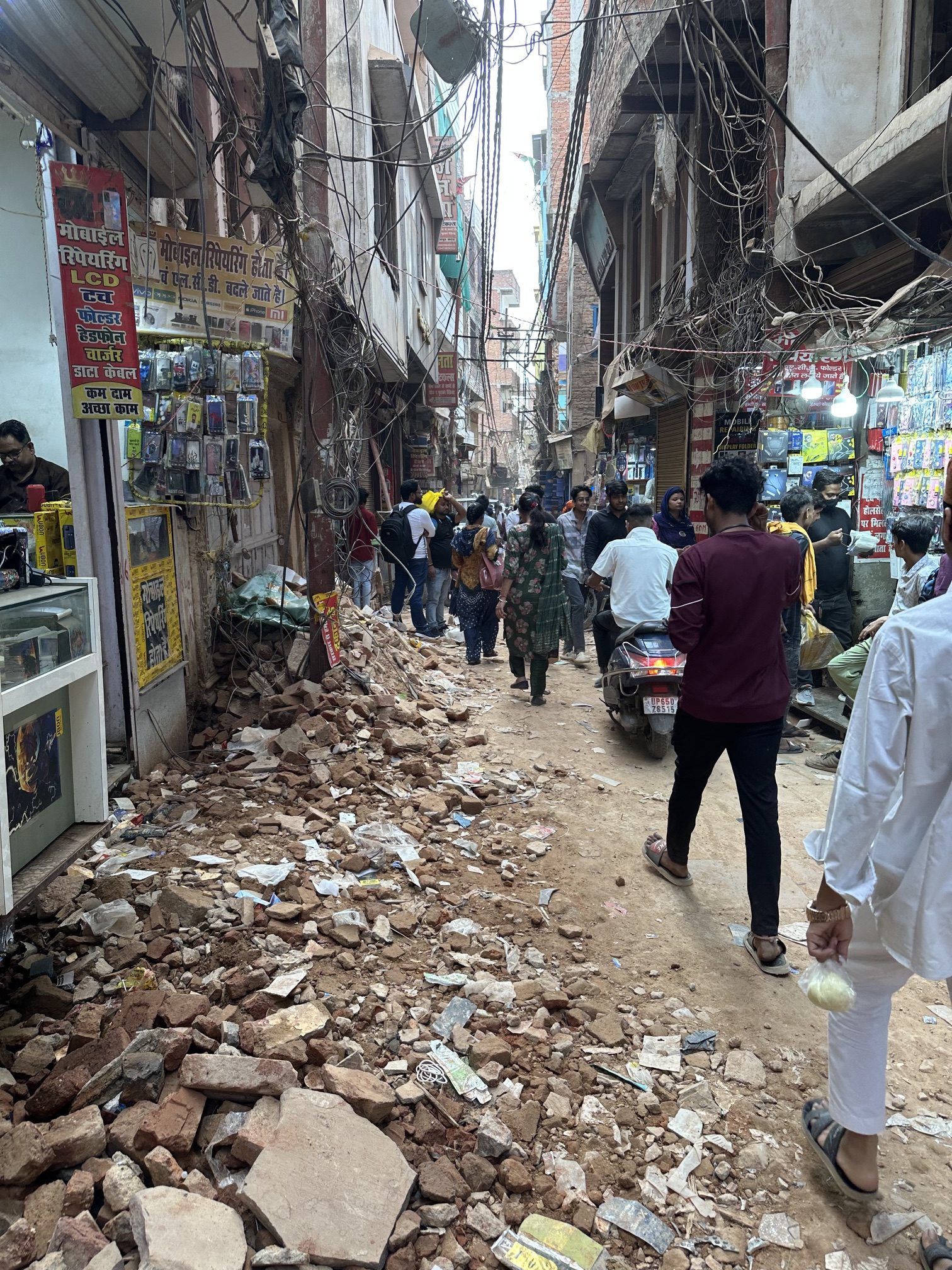
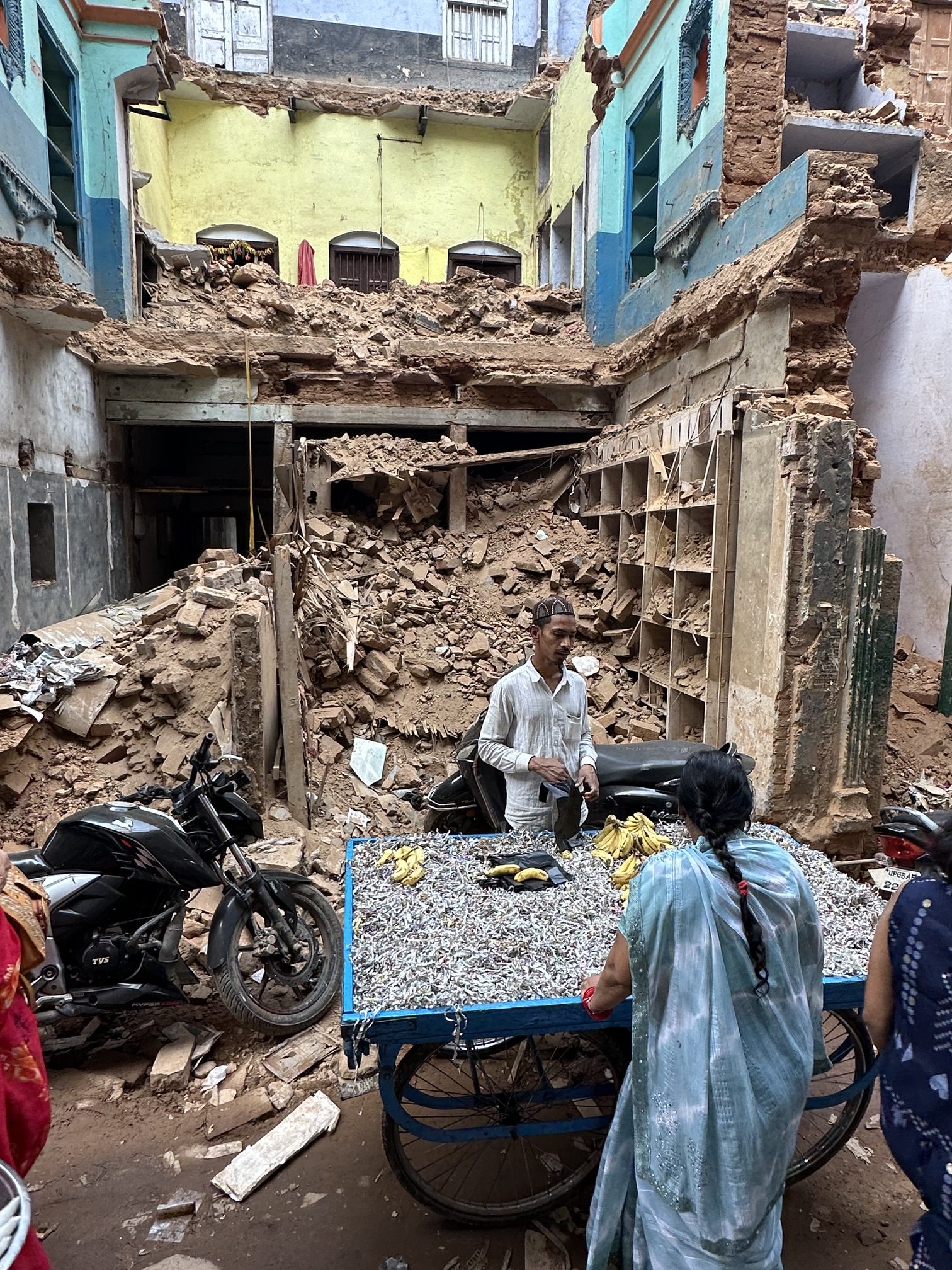
Suddenly, the system becomes paralyzed.
The government looks at a neighborhood and sees an obstacle, but it looks at a shrine and sees a political liability. Engineering plans are reconsidered, routes are altered, and decisions become the structure is socially, culturally and religiously radioactive. To remove it is to gamble with a level of public backlash and organized protest that far exceeds the inconvenience of a permanent highway bottleneck.
In the end, the system isn’t adapting out of pure reverence, it’s a cold, practical recognition of limits. It’s the government asserting control where it can and backing off where it must.
The World Adjusts Around Him
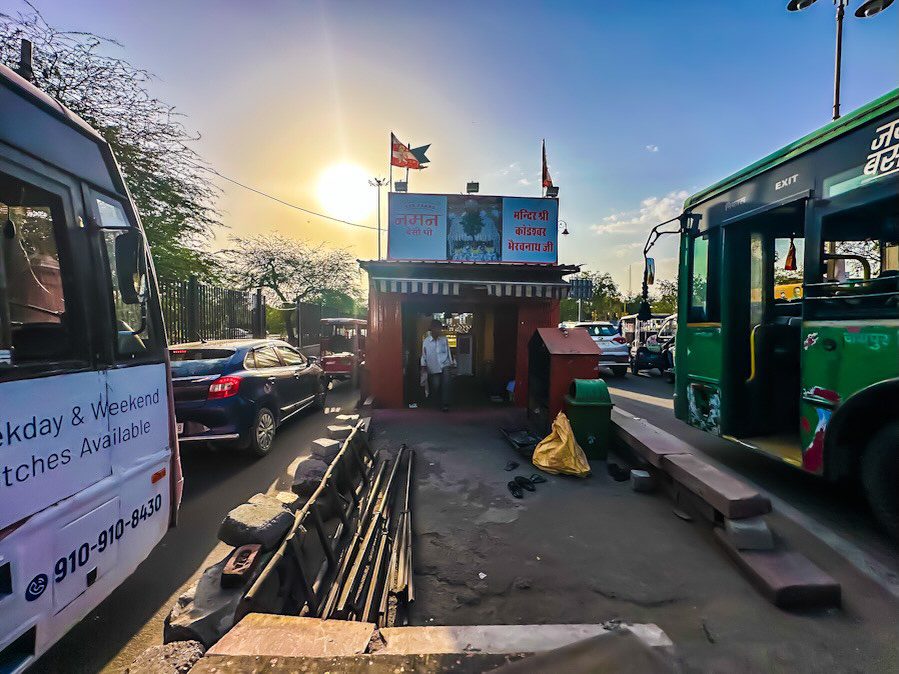
I am tempted to interpret this as a form of social harmony, some poetic Indian dance of coexistence between tradition and modernity. But the coexistence is not seamless, and it’s not rational – at least not in any way I can even try to explain. It is shaped by opposing power dynamics and an unresolved process of adjustment that will never resolve. Ever. This temple doesn’t symbolize balance. It embodies tension.
The road reveals a different way of responding to fixed realities. Nothing is trying to eliminate the obstacle, nor insisting on a logical resolution. Instead, the road and traffic adjust continuously, maintaining flow without requiring the situation to change. This is a kind of functional intelligence that recognizes where effort is effective and where it’s a complete waste of time. The traffic flows because it has incorporated the temple into the flow of life. It navigates the tension without any attempt to resolve it.
I can watch the world flow around what won’t move.
Inside me, I’m the thing that won’t move.
Learning to Let Chaos Flow
What makes this more than just an external observation for me is the way it reflects a pattern I can’t distance myself from. My instinct is to organize, clarify, fix, and even demand coherence from life’s encounters. But these months in India reveal the same “immovable” patterns showing up in spaces where I can no longer hide behind. I can’t use “cultural curiosity” as an excuse.
Recently, I had a dream about my father. We were arguing about something I couldn’t name, but I was already holding an immovable position. He mentioned he had a doctor’s appointment. I heard his words, but they didn’t bring pause or move me toward him. It registered as data, without even a concern. I had somewhere else to be, something social I had already decided mattered more than my father’s vulnerability.
Even after he returned from the doctor, I didn’t ask him about it. I was so stuck in my own beliefs that it didn’t even occur to me to step outside my own world. Something was immovable inside me—an opinion, an irritation, a way of seeing him—that had already dictated how I defined the moment. I was not open for curiosity or to be concerned about anything but myself. Everything else had to move around my position, and it did.
The Fixed Point
After a while, I became more lucid in my dream state. I could still feel the irritation, but it was no longer about my father. And then the thought came, dude… your father is dead. Why am I still holding onto all this strife? What is all this asking from me, now?
Nothing got resolved in the dream itself. There was no shift towards him and no sudden tenderness that I could access to make me feel redeemed. Just the awareness that my father is dead and I’m too late to change anything.
What it did was expose something more familiar than I want to admit. I keep thinking life presents to me immovable things, these fixed points that I have to learn to accept or move around. But that’s not quite the truth.
What if I’m not the road learning to move around the fixed point… What if I’m the thing that is the fixed point?
That’s what the dream showed me. It wasn’t a difficult situation or an unchangeable reality. It was just me stuck in a position that felt completely justified. I was completely closed to other ways to see the situation. Once I became hardened like that, everything else had to adjust around it. Not because it should, but because that is how I made it so. And I don’t always catch myself in time.
Even when I can feel something in me tighten into a “right’ position. I don’t always know how to step out of it while it’s happening. Awareness might show up, but it doesn’t interrupt anything. It just stands there, watching the moment pass, watching the distance form, watching the opportunity close.
By the time I can recognize it, I’m already on the other side of it. With a mess I need to clean up.
Standing in the middle of that highway, I thought I was looking at something external—a world that organizes itself around what refuses to move. I thought I was witnessing a kind of cultural logic, a different relationship to order and chaos.
I wasn’t.
The road didn’t get re-engineered because the temple was in the middle. There was no argument or attempt to move it out of the way. It adjusts because it has no choice.
I’d like to think I can do the same. But that’s not what this situation was showing me about myself.
More often than not, I’m the thing everything else has to move around.
And I’m still there, long after the moment has passed.